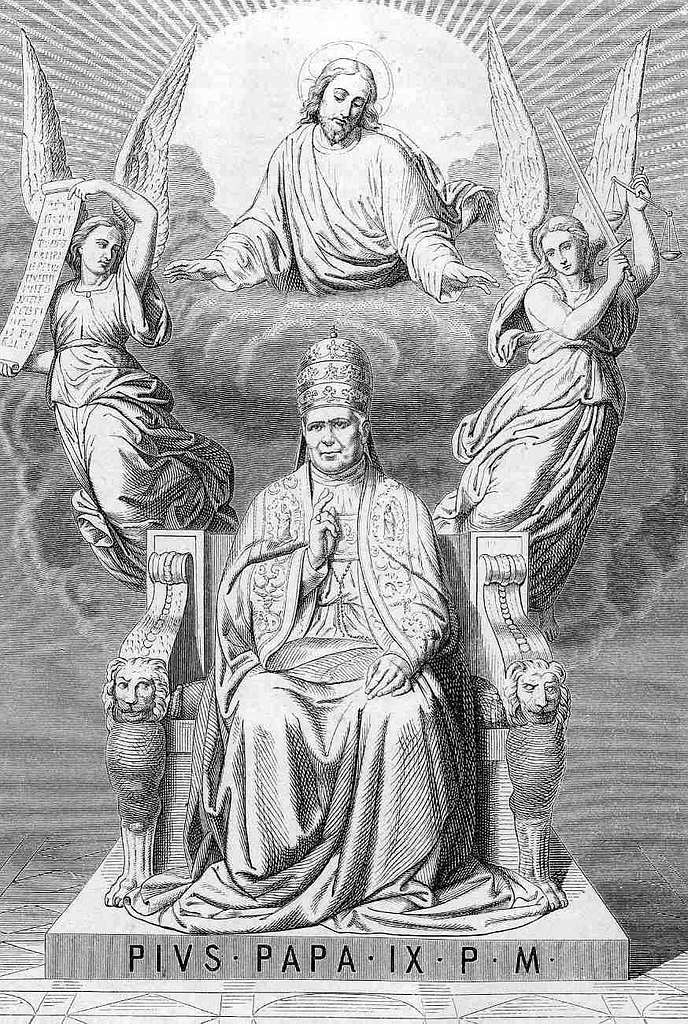
Ordos are no longer printed for these rubrics. This one is made to fill that gap: a working ordo for the Roman Rite as it was kept under Pius IX, from 1846 to 1877, under the Tridentine books and rubrics, before the changes of Leo XIII, who came to the throne on 20 February 1878. One liturgical state is applied to every day shown here, and it is worked out for the present calendar.
What it is
The Office and Mass of each day are computed from the rubrics themselves: which feast is kept when two fall together, what is transferred and what is omitted, the octaves, the commemorations, and the concurrence of Vespers, with the Mass, colour, Preface, Gloria and Credo, and the hours of the Office that follow from them. It is an ordo for the universal Roman calendar, made for those who keep, or wish to follow, these rubrics.
Local and particular material is not shown: diocesan and religious proprias, the Proprium Cleri Romani, and feasts peculiar to one country. Where a printed directory of the period gave such a feast, it was recognised as local and left out. The reigning pope, Leo XIV, is named only for the anniversary of his coronation.
Sources
Every rule was read from the printed books of the period, and where sources disagreed the difference was traced before anything was changed.
- The rubrics. The Rubricae Generales of the Breviary (Tramater, Naples 1846) and of the Missal (Propaganda, Rome 1872), given in full on the Rubricae Generales page. The Breviary tables of occurrence and concurrence were compared with the 1854 edition.
- The calendar and ranks. The Kalendarium of the 1872 Missal, and the classification of feasts printed in the Breviary of 1846, with the Breviaries of 1854 and 1876 for the additions of Pius IX.
- Printed ordos. The Australasian Catholic Directory for nine years between 1854 and 1876, keeping to its universal entries and setting aside those marked as particular to the Roman clergy or to Ireland. It is an Australian book with feasts of its own, so it is used to check the rubrics and never to overrule them.
- Other witnesses. The Directorium of Gniezno for 1847 and the Polish ordos of the following decades, for the dates of translated feasts.
Where no second directory covers a day, the rubrics and the Kalendarium decide it.
The Tridentine rubrics
The rubrics followed are those of the Breviary and Missal of St. Pius V, as revised by Clement VIII and Urban VIII and as printed in the books of Pius IX’s time. In practice this means:
- Feasts are ranked as Doubles of the first and second class, Doubles major and minor, Semidoubles and Simples. Feasts of the same class are settled by the order of Tit. XI.2: the feasts of the Lord, then those of Our Lady, then the Angels, St. Joseph and the Apostles, then the other Saints. There is no list of primary and secondary feasts.
- A Double that falls on an ordinary Sunday is kept and the Sunday is commemorated. On the Sundays named in the rubrics, and on the other days they name, a Double or a Semidouble is not kept but translated to the first day free of a Double or a Semidouble.
- Octaves are commemorated by the named list of feasts, not by a rule of rank, and Sundays within octaves keep their own Offices.
- Vespers are settled by the concurrence table of the Breviary: the whole of the preceding, or of the following, or a division from the Chapter.
- The Missal gives the first day of each month, and every Monday on which the Office is of the feria, to the dead. Where no Double or Semidouble is kept, and outside Lent and Paschaltime (and, for the first of the month, Advent), the principal Mass may be a Requiem; this is the “For the dead” line under the Mass. Where the day has a Simple, or a feria with a Mass of its own, the Mass of the day is said with the oration Fidelium for the dead, which the Missal always places next to last, so with three orations it is the second (Tit. V and VII.6).
- Some feasts are kept on a Sunday and not on a fixed date, for example the Patronage of St. Joseph on the third Sunday after Easter, the Precious Blood on the first Sunday of July, St. Joachim on the Sunday after the octave of the Assumption, and the Seven Dolours on the third Sunday of September.
- The Psalter is the Roman Psalter of the Breviary of Pius V, with its own ferial distribution, Preces and Suffrages.
What Leo XIII changed later, which is not here
The printed rubrics of Leo XIII’s pontificate differ from those of 1846 and 1872, and the changes that came after them altered more. None of it is applied in this ordo:
- Primary and secondary feasts. The catalogue of the Sacred Congregation of Rites (27 August 1893 and 5 February 1895) sorts feasts of one class into greater and lesser and settles who has the Vespers when they meet. It is not used.
- Reduction to a Simple. The later rubrics let an impeded feast be reduced to a Simple (ad instar Simplicis, per modum Simplicis), with its commemoration and ninth lesson. In 1846 and 1872 an impeded Double or Semidouble is translated, or commemorated or omitted only in the cases the rubrics name.
- The Suffrages. Tit. I.6 in 1846 names the Suffrages of the Blessed Virgin, the Apostles and Peace. The later text adds St. Joseph and the titular saint.
- The Doctors. Ss. Cyril of Alexandria and Cyril of Jerusalem (1882), John Damascene (1890) and Bede (1899) are not in the 1872 Missal or the 1876 Breviary, and are not in this ordo, nor are the feasts added after 1878.
- Later rubrics. The Divino Afflatu reform of 1911 and every rubrical change after it are outside this ordo.
Contact
The ordo is built from the rubrics and the printed sources of the period, and each rule has been checked against them. If you find a day that differs from a book you hold, or have a question, write with the date and the book or page.